
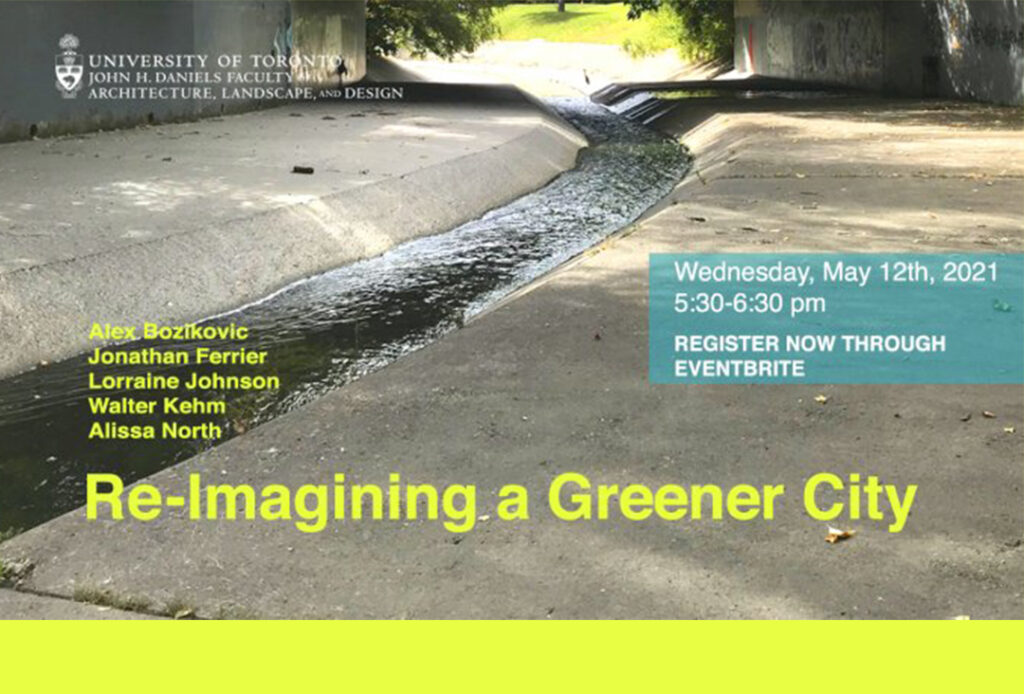
“Re-Imagining A Greener City” has been added as a fourth webinar in the Accidental Wilderness series, due to the popularity of these events.
Toronto has recently enacted several strategies toward becoming greener. This includes initiatives such as Toronto’s Biodiversity Strategy, Pollinator Strategy, Tree Planting Strategy to get to 40% canopy cover, Parkland Strategy, Green Standard, Ravine Strategy, and Resilience Strategy, to name a few. What do these strategies look like on the ground and what are their potentials for achieving a “greener” city?
Cities have hundreds of hectares of land that are not utilized to their full green potential. Tree wells could be expanded as biodiverse planting beds, railway and utility rights-of-way, industrial lands, port lands, existing parks, and golf courses can be ecologically retro-fitted, roof tops and hydro corridors can absorb storm water and decrease urban heat, clover covers can replace lawns, streets can be intensively greened and pedestrian-oriented, and new habitat parklands can be introduced to the Toronto waterfront. These Integrated city-wide reimaginations have the potential to move Toronto from reliance on grey infrastructure, requiring constant and expensive reconstructions, toward self-renewing natural infrastructure, that will address larger climate concerns.
This webinar will present the ideologies and dreams of four panelists. They are passionate about the ecological and cultural health of our urban environments. Their understandings and experiences range from implementation of green technologies to the millennia of Indigenous living in balance on the land. The links between human health are intricately involved with accessible connections to nature. The Covid-19 pandemic in particular, has revealed the inadequacies of the city’s green infrastructure. The panelists will discuss new proposals for increasing Toronto’s greenness, as spaces for thriving ecological health and ongoing regenerative processes.
The event will be introduced and moderated by Alex Bozikovic, The Globe and Mail’s architecture critic. Lorraine Johnson will present Toronto’s natural garden exemption, in relation to the city’s biodiversity and pollinator strategies; Walter Kehm will present his work at Humber Bay Park; Alissa North will present her research and imaginative design proposals for the ravines and intense urban spaces; and Jonathan Ferrier will present ecological frameworks from the territory. The succinct presentations will be followed by a half-hour discussion, where questions via chat are welcomed.
