
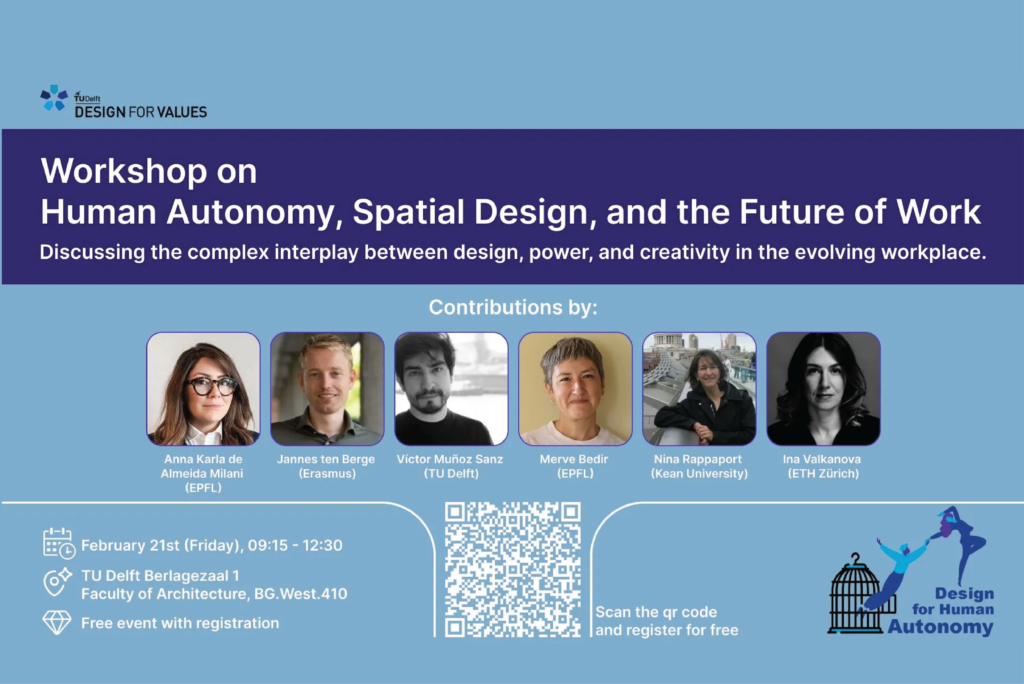
On 21 February, the workshop ‘Human Autonomy, Spatial Design, and the Future of Work’ takes place.
As autonomous technologies continue to transform workplaces and daily life, the question of human autonomy takes center stage. Once viewed as tools to expand freedom, these technologies now risk eroding human control and agency, particularly in the realm of work. This event explores how (spatial) design intersects with these issues, probing its role in shaping environments that either empower or manipulate workers.
From managerial strategies that influence behavior to the enduring value of craftsmanship in a world increasingly dominated by automation and AI, the discussion addresses the complex interplay between design, power, and creativity in the evolving workplace.
Through these perspectives, we aim to spark dialogue among designers, researchers, and students about how to (re)align technology and workspaces with the principle of human autonomy. How can we ensure that design fosters inclusion, justice, and sustainability in a rapidly changing technological landscape? By grappling with these questions, this event seeks to inspire actionable ideas for futures where technology enhances, rather than diminishes, human agency.
This seminar is part of the program around the annual theme for 2024-2025 of the Delft Design for Values Institute, “Design for Human Autonomy,” and will count with contributions by Nina Rappaport (Center for Urban Industry, Kean University), Ina Valkanova (ETH Zürich), Merve Bedir (Geo-Design Department, Design Academy Eindhoven; EPFL), Jannes ten Berge (Erasmus School of Social and Behavioural Sciences), Anna Karla de Almeida Milani (Heritage, Anthropology, and Technologies, EPFL), and Víctor Muñoz Sanz (Urbanism, TU Delft).
The event is convened by Víctor Muñoz Sanz, Critical Environments Group, Section of Urban Design TU Delft, in collaboration with the Delft Design for Values Institute.
